


Appointments
Request Appointment/Request Exam - After completing the respective forms, these requests will be processed by our services, and you will receive confirmation by email. The indications about the Agreements (Insurance/Subsystem) are merely informative, please request confirmation in the "Observations" field.
Schedule Appointment/Exam myHPA - By accessing myHPA Saúde you can make the appointment in real time, directly on the Doctor's schedule according to his availability.
You can also contact us at +351 282 420 400 Algarve | +351 269 630 370 Alentejo | +351 291 003 300 Madeira
Phone booking/service hours:
Monday to Friday: 8:00 AM to 7:00 PM, Saturday: 8:00 AM to 5:00 PM Sunday and Holidays: Closed
(National landline)
Your request has been successfully received. We will confirm your appointment shortly.
Download myHPA Saúde:


Main Therapeutic Procedures
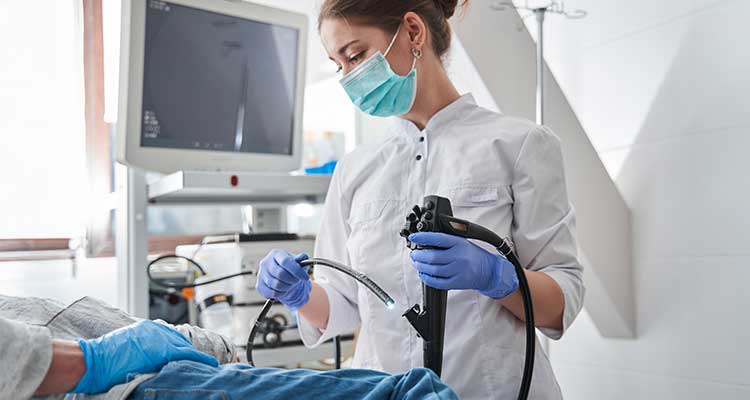
In Gastroenterology, technological advances and the evolution of techniques now make it possible to treat a wide range of gastrointestinal conditions in a minimally invasive, safe and effective manner, often avoiding more complex surgery and prolonged hospital stays.
From the treatment of obesity and oesophageal motility disorders to the removal of pre-malignant lesions and the urgent control of gastrointestinal bleeding, endoscopic procedures have established themselves as a modern, precise solution with rapid recovery.
Through specialised techniques performed by upper gastrointestinal endoscopy or colonoscopy, it is possible to intervene directly in the oesophagus, stomach, small intestine and colon, delivering improved clinical outcomes, reduced post-procedure discomfort and a lower risk of complications.
Below, we present the main therapeutic procedures performed, together with their indications and benefits for the patient.
- Dra. Ana Margarida Vieira
- Dr. André Sancho Ramos
- Dr. Bruno Peixe
- Dra. Helena Tavares de Sousa
- Dra. Maria Margarida Sampaio
- Dra. Patrícia Queirós
- Dra. Ana Rita Herculano
- Dr. André Sancho Ramos
- Dr. Diamantino Sousa
- Dr. Francisco Açucena
- Dr. Horácio Guerreiro
- Dr. Mário César
- Dr. Horácio Guerreiro
CUF Alvor Hospital
CUF Faro Hospital
Hospital São Camilo - Portimão
CUF S. Brás de Alportel Clinic
| Find all the information regarding Specialities and Consultations at CUF Healthcare Units in Greater Lisbon, the North, Centre, and the Azores here. |
Intragastric Balloon Placement
Intragastric balloon placement is an endoscopic therapeutic procedure intended for the treatment of obesity. It involves introducing a silicone balloon into the stomach via upper gastrointestinal endoscopy, which is then filled with liquid or air. The balloon occupies space within the stomach, promoting early satiety and reducing food intake, and is always combined with nutritional and medical guidance.
The procedure is performed under sedation and is safe and temporary, with the balloon remaining in the stomach for 6 to 12 months before being removed endoscopically. Its aim is to support weight loss and reduce obesity-related risks such as diabetes, hypertension and cardiovascular disease, serving as a complementary tool to lifestyle changes.
Dilatation of Gastrointestinal Strictures with Endoscopic Stent Placement
This therapeutic endoscopic procedure involves widening narrowed areas of the gastrointestinal tract (such as the oesophagus, stomach or intestine) using balloons or other devices introduced endoscopically.
When necessary, a stent is placed to keep the passage open, allowing food and liquid intake or adequate drainage in cases of obstruction caused by tumours, inflammation or scarring. The procedure is usually performed under sedation and may be used for symptom relief, temporary management or as preparation for further interventions.
Endoscopic Submucosal Dissection (ESD)
Endoscopic submucosal dissection is an advanced therapeutic endoscopic technique that enables the removal of large or complex polyps or early-stage tumoural lesions of the gastrointestinal tract without the need for surgery.
The procedure uses high-resolution endoscopy and precision instruments, such as fine endoscopic knives, to carefully separate and remove the lesion in one piece. This approach ensures clear margins, which are essential for therapeutic success and potential curative treatment.
Essentially, it represents a form of minimally invasive endoscopic microsurgery that is safe and effective. Hospital stay is usually less than 24 hours, with rapid recovery and reduced patient burden compared to more invasive surgical procedures.
Percutaneous Endoscopic Gastrostomy (PEG)
PEG is a procedure that allows direct feeding into the stomach when oral intake is difficult, impossible or unsafe, such as in cases of swallowing disorders, neurological diseases, surgeries of the mouth or oesophagus, or prolonged coma.
The procedure is performed using upper gastrointestinal endoscopy to guide the placement of a feeding tube through the abdominal wall into the stomach. The tube allows safe administration of nutrition and fluids and may be temporary or permanent, depending on the patient’s clinical condition.
PEG requires ongoing care, including maintaining skin hygiene around the tube, monitoring device integrity and preventing complications such as tube displacement, infection, obstruction or aspiration. With appropriate monitoring, the procedure is safe and ensures adequate nutrition when oral feeding is not possible.
Endoscopic Haemostasis
In emergency situations such as gastrointestinal bleeding originating from the stomach, duodenum, small intestine or colon, endoscopic treatment is the first-line approach.
Currently, several effective techniques are available to control bleeding, including injection of sclerosing agents, application of endoscopic clips and coagulation methods, enabling rapid, safe and minimally invasive intervention.
Endoscopic Band Ligation of Oesophageal Varices
Endoscopic band ligation is a therapeutic procedure used to treat or prevent complications associated with oesophageal varices. Oesophageal varices are dilated, abnormal veins, usually located in the lower oesophagus, that arise as a consequence of chronic liver disease and carry a high risk of bleeding.
The procedure involves placing small elastic bands around the varices via an endoscope, causing occlusion and subsequent scarring. Band ligation may be performed prophylactically in patients at high risk of bleeding or as an emergency treatment when active upper gastrointestinal bleeding from oesophageal varices is present, effectively controlling haemorrhage.
Peroral Endoscopic Myotomy (POEM)
Peroral endoscopic myotomy is an adaptation of endoscopic dissection techniques developed for the treatment of oesophageal motility disorders, such as achalasia, as well as certain congenital conditions, including Zenker’s diverticulum.
By applying the principles of endoscopic dissection, this technique allows controlled myotomy (sectioning of muscle fibres) in a safe and minimally invasive manner, significantly reducing the risk of organ perforation.
Previously, such patients often required complex, high-risk surgery. With this innovative technique, treatment can now be performed entirely endoscopically, without external scars, with short hospital stays and rapid recovery.
Mucosectomy
Mucosectomy is a minimally invasive endoscopic procedure used to remove tumoural lesions located in the superficial layers of the intestine, specifically the mucosa and submucosa. It is performed during colonoscopy or upper gastrointestinal endoscopy using a thin, flexible tube equipped with a camera, forceps and an electrosurgical knife, allowing precise visualisation and removal of the lesion.
This procedure is safe, virtually painless and enables rapid recovery, avoiding more invasive surgery. Mucosectomy is indicated for lesions that have not penetrated deeper layers of the gastrointestinal wall, helping to prevent progression to serious conditions such as colorectal cancer.